


Force vs. Mass in Portable Weighing: Why Local Gravity Matters
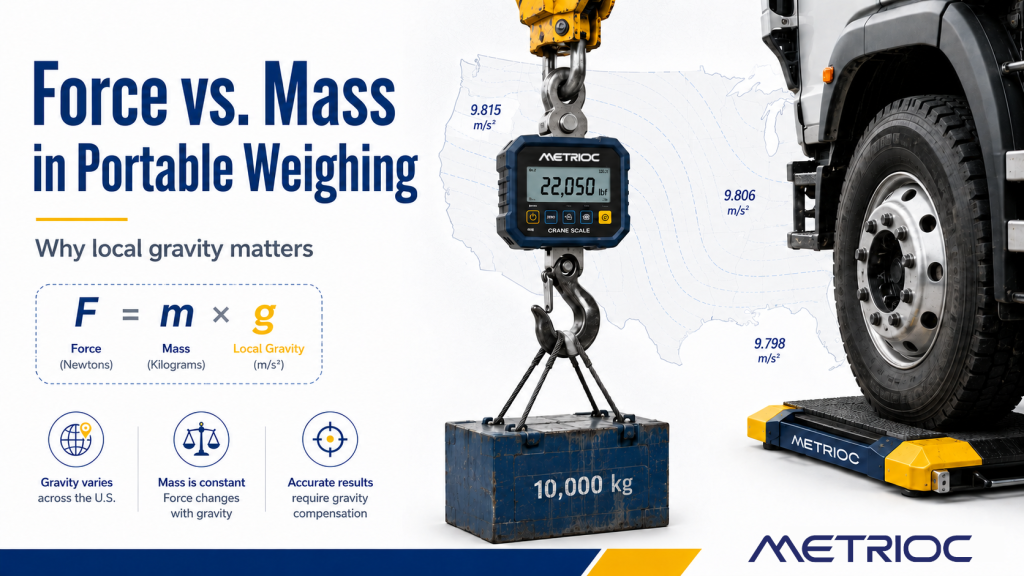
A load does not gain or lose mass simply because it is moved from one location to another. But the gravitational force acting on that load can change.
For fixed weighing systems, this usually causes little concern because the instrument is adjusted, calibrated, or verified where it is used. Portable weighing devices create a different situation.
Crane scales, wheel-load weighers, portable load-cell systems, tension links, and similar devices may be calibrated or configured in one location and then used hundreds or thousands of miles away. Because local gravity varies with latitude, elevation, and local geological conditions, the same mass can apply a slightly different gravitational force at a different location.
The mass has not changed. The force has.
That distinction becomes important whenever a force-responsive device is used to determine mass.
Force vs. Mass: What Is the Difference?
Understanding the difference between force and mass is the foundation for understanding why local gravity matters in portable weighing.
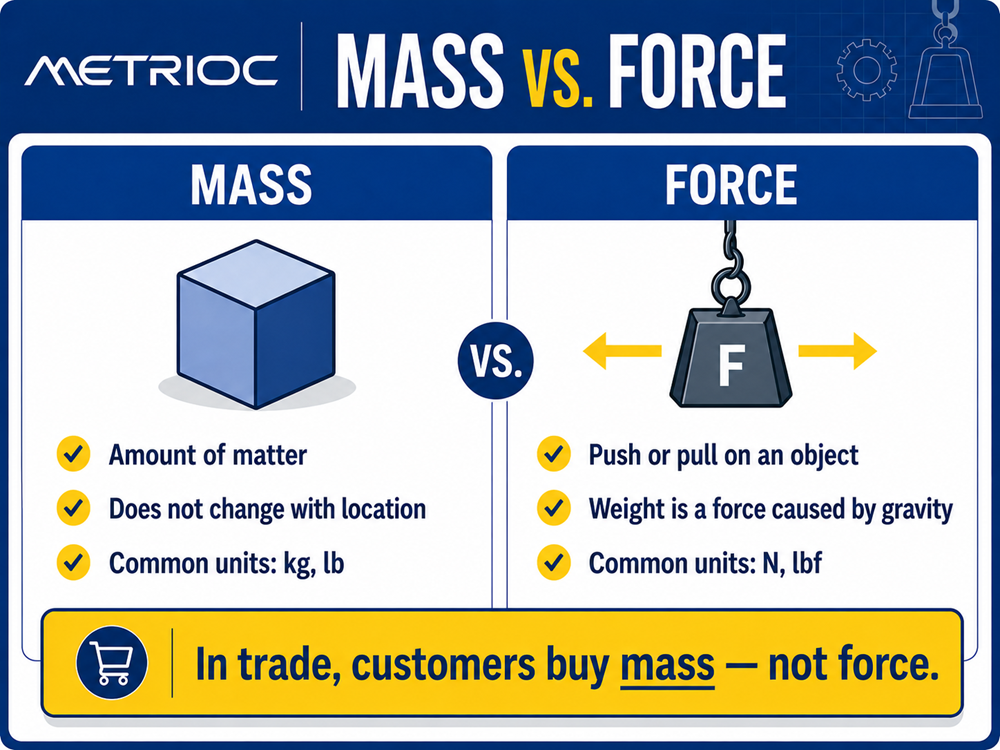
Mass is a physical property of an object associated with the amount of matter it contains and its resistance to acceleration. An object’s mass does not change simply because the object is moved to another geographic location.
Common units of mass include the kilogram, kg, and the pound, lb.
Force is different. A force is a push or pull acting on an object. In the International System of Units, force is measured in newtons, N. In U.S. customary engineering applications, force is also commonly expressed in pound-force, lbf.
Newton’s second law relates force, mass, and acceleration:
F = m × a
When the acceleration is caused by gravity:
F = m × g
where F is gravitational force, m is mass, and g is local acceleration due to gravity.
This relationship explains the central issue in force-based weighing. The mass of an object remains essentially constant when it is moved, but the gravitational force acting on that mass depends on the local value of g.
A force-responsive sensor therefore does not directly sense mass. It responds to applied force. If the purpose of the measurement is to determine mass, the weighing system must correctly establish the relationship between the measured force and local gravitational acceleration.
Does a Scale Measure Mass or Force?
In most weighing applications, the quantity the user ultimately wants to know is mass. However, many weighing instruments determine that mass through a mechanism that responds to gravitational force.
According to the NIST Guide to the SI, mass and weight are different quantities. Mass describes an object’s inertial property or amount of matter, while weight is the force associated with gravity acting on that mass..
In everyday language and commercial transactions, however, the word weight is often used to mean mass. A customer purchasing 10,000 lb of material is concerned with receiving 10,000 lb of mass, not a particular value of gravitational force.
A strain-gage load cell, for example, responds to applied force. When it is incorporated into a scale, crane scale, wheel-load weigher, or other weighing system, the complete instrument uses that response to produce a mass indication such as kilograms or pounds.
The underlying relationship remains:
F = m × g
For a weighing instrument installed, adjusted, and used at one location, the system can be configured so its displayed mass correctly represents the applied load under local gravitational conditions.
Portable weighing devices require more attention because the location where the instrument is calibrated, adjusted, or configured may differ from where it is used.
The sensor may respond to force, while the complete weighing system is intended to report mass.
lb vs. lbf: Pound-Mass and Pound-Force Are Different
The distinction between mass and force can be especially confusing in U.S. customary units because pound and pound-force are sometimes used loosely in conversation.
They are not the same physical quantity.
The pound, symbol lb, is a unit of mass. The pound-force, symbol lbf, is a unit of force.
Their relationship uses conventional standard gravity:
gₙ = 9.80665 m/s²
One pound-force is the force corresponding to a one-pound mass under standard gravity. Therefore:
1 lbf = 4.4482216152605 N
Standard gravity is a defined reference value. It is not the exact local acceleration due to gravity everywhere on Earth.
For a mass expressed in pounds, gravitational force in pound-force can be written as:
F(lbf) = m(lb) × g_local / gₙ
Conversely, when a force-measuring instrument reports lbf and the objective is to determine mass in lb:
m(lb) = F(lbf) × gₙ / g_local
If local gravity equals standard gravity, the numerical values of lb and lbf happen to be equal. That numerical equality does not mean the units represent the same quantity.
This distinction is essential when crane scales, load cells, tension links, wheel-load weighers, or other portable force-measuring devices are used to determine mass.
Why Does Local Gravity Change With Location?
Local gravity is not exactly the same everywhere on Earth.
The commonly used value of 9.80665 m/s² is conventional standard gravity, not the actual gravitational acceleration at every location.
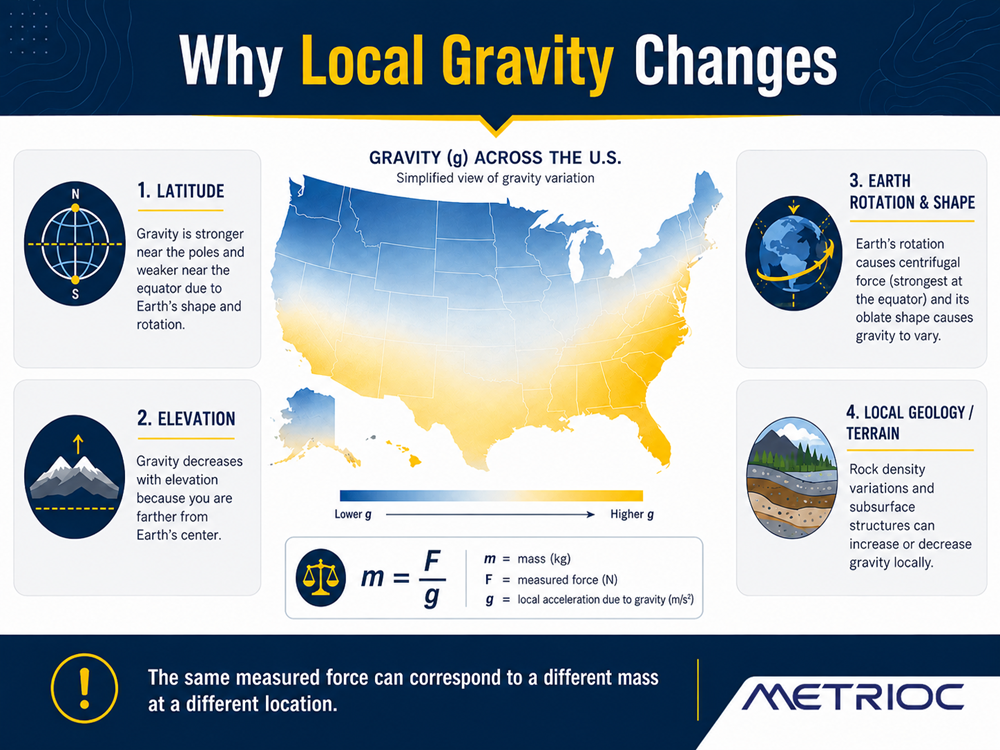
Latitude is one important factor. Earth rotates, and the centrifugal effect of that rotation is greatest near the equator and decreases toward the poles. Earth is also slightly flattened at the poles and wider around the equator. Together, these effects make normal gravity generally lower near the equator and higher toward the poles.
Elevation also matters. As elevation increases, a location is farther from Earth’s center, so gravitational acceleration generally decreases.
Local geology and terrain can produce smaller additional variations. Differences in rock density, mountain ranges, sedimentary basins, and subsurface structures affect the local gravitational field.
For very high-accuracy work, smaller time-dependent effects such as Earth tides may also become relevant. For most industrial portable weighing applications, however, latitude and elevation are the dominant practical factors to consider first.
If mass remains unchanged but local gravity changes, the force applied to a crane scale, load cell, or wheel-load weigher also changes:
F = m × g_local
Whether the resulting difference is important depends on the load, the change in local gravity, the instrument’s accuracy, and the uncertainty required for the measurement.
How Is Local Gravity Determined?
Local gravity can be estimated in several ways, depending on the accuracy required.
For many engineering applications, a practical starting point is the Geodetic Reference System 1980, or GRS 80. GRS 80 provides normal gravity as a function of latitude while accounting for Earth’s shape and rotation.
Because gravity also changes with elevation, the latitude-based value can be adjusted using an elevation correction. Combining GRS 80 normal gravity with an elevation correction provides a useful estimate for many preliminary engineering calculations.
However, this remains a mathematical estimate. It does not account for all local variations caused by geology, terrain, or other differences in Earth’s gravitational field.
For more site-specific information, NOAA’s National Geodetic Survey provides gravity data and prediction tools. NGS Surface Gravity Prediction determines surface gravity at a specified geographic position and topographic height by interpolation based on observed gravity values.
Because NOAA/NGS predictions incorporate observed geodetic gravity information, they may differ slightly from a calculation based only on GRS 80 and elevation.
If mass is calculated from force using:
m = F / g
then uncertainty in g contributes to uncertainty in the calculated mass. The quality of the gravity value should therefore be appropriate for the accuracy required by the application.
Why Fixed Scales Are Less Affected by Local Gravity
For a scale that remains at one location, local gravity is usually handled as part of installation, adjustment, calibration, or verification.
A laboratory balance, retail scale, or permanently installed industrial weighing system is normally configured where it will be used. The relationship between the force sensed by the weighing mechanism and the displayed mass can therefore be established under essentially the same gravitational conditions in which the instrument operates.
The issue becomes more important when an instrument is moved far enough geographically or in elevation for the change in local gravity to matter relative to its accuracy requirements.
A precision balance moved across a room will not experience a meaningful change in local gravity. Moving the same instrument from a low-elevation location to a high-elevation location can be different.
Whether adjustment or reverification is necessary depends on instrument resolution and accuracy, the change in location, manufacturer requirements, intended use, and applicable legal-metrology requirements.
A fixed scale is generally adjusted and used under the same local gravitational conditions. A portable weighing device may not be.
Why Local Gravity Matters for Portable Weighing Devices
A crane scale, wheel-load weigher, portable load-cell system, or tension link may be calibrated, adjusted, or configured at one location and then transported elsewhere for use.
If the device responds to force, the force applied by a mass at the point of use is:
F = m × g_local
The mass does not change when the device moves. But if local gravity changes, the gravitational force applied to the sensor changes slightly.
This is particularly important when a device has been calibrated as a force-measuring instrument.
For example, a load cell may receive a traceable calibration in newtons or pound-force at a force calibration laboratory. That calibration establishes how the instrument responds to applied force.
If the same load cell is later used to determine mass, the complete measurement system must also account for the relationship between force and mass at the location of use. A force calibration alone does not eliminate the effect of local gravity.
Some complete portable weighing instruments include gravity compensation, geographic settings, or adjustment procedures. Others may require calibration or verification at the intended location.
The practical question is therefore not simply:
“Was the sensor calibrated?”
It is:
“Does the complete weighing system correctly convert the force applied at this location into the mass value that needs to be reported?”
Same Cargo, Different Location: A Portable Weighing Example
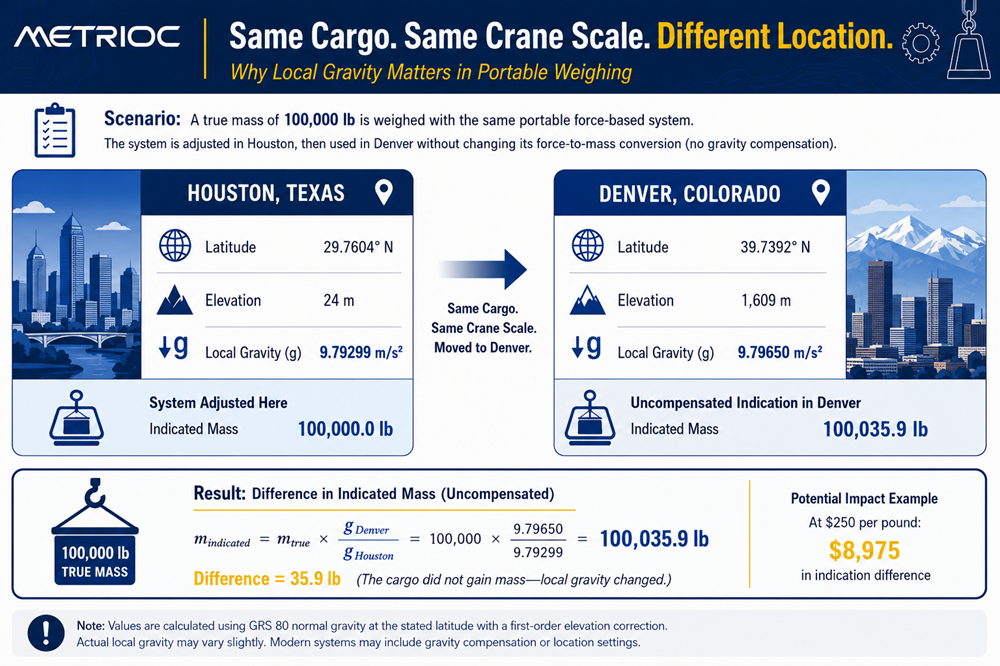
Consider a hypothetical high-value shipment with a true mass of 100,000 lb.
Assume a portable force-based weighing system is adjusted in Houston, Texas, so the load indicates exactly 100,000 lb there.
For a reproducible example, use representative Houston coordinates of approximately 29.7604° N and an elevation of about 24 m. Using the same GRS 80 normal-gravity equation and first-order elevation correction used by the Metrioc calculator gives:
g_Houston ≈ 9.79299 m/s²
Now suppose the same system is transported to Denver, Colorado, without changing its force-to-mass conversion or applying gravity compensation.
Using representative Denver coordinates of approximately 39.7392° N and an elevation of about 1,609 m gives:
g_Denver ≈ 9.79650 m/s²
The cargo still has a true mass of 100,000 lb. Nothing has been added or removed.
For an uncompensated system still referenced to the Houston conditions:
m_indicated = m_true × g_Denver / g_Houston
m_indicated ≈ 100,000 × 9.79650 / 9.79299
m_indicated ≈ 100,035.9 lb
The difference is approximately 35.9 lb.
The shipment has not gained 35.9 lb of mass. The change results from the different gravitational force acting on the same mass and the way the hypothetical system converts force into a mass indication.
If a high-value material were worth $250 per pound, an uncompensated 35.9 lb indication difference could correspond to approximately:
35.9 lb × $250/lb ≈ $8,975
This example does not imply that every crane scale moved between Houston and Denver will show this error. Modern systems may incorporate gravity compensation, location settings, adjustment procedures, or other corrections.
It demonstrates the underlying principle: the mass remains the same, but the gravitational force produced by that mass can change with location. If a portable weighing system does not account for that change, its indicated mass can also change.
Force Calibration vs. Weighing Calibration: Why the Difference Matters
Force calibration and weighing calibration are related, but they do not establish the same measurement quantity.
A force calibration determines how an instrument responds to applied force. ASTM E74, for example, provides procedures for calibration of static force-measuring instruments so their force characteristics can be established and made traceable to the SI.
A weighing system has a different objective. Its purpose is generally to determine or indicate mass, even though its sensing element may respond to gravitational force.
A force-calibrated load cell therefore does not automatically become a location-independent weighing system simply because its force calibration is traceable.
If the instrument is used to determine mass, the relationship among force, mass, and local gravity must also be established:
m = F / g_local
For commercial weighing in the United States, NIST Handbook 44 provides specifications, tolerances, and technical requirements for many weighing devices. Internationally, OIML R 76 addresses non-automatic weighing instruments and specifically recognizes that gravity-sensitive instruments may require consideration of gravity at the intended location of use.
A load cell, crane scale, or other device may have an excellent force calibration while the complete weighing system still requires appropriate gravity compensation, adjustment, calibration, or verification before providing the required mass indication at another location.
Does Air Buoyancy Affect Weighing?
Local gravity is not the only physical effect that can influence high-accuracy weighing.
Objects weighed in air experience an upward buoyant force caused by the air they displace. Its magnitude depends mainly on air density and the volume of the object.
Gravity and air buoyancy are separate effects. Gravity determines the downward force associated with mass, while air buoyancy produces an opposing upward force.
For most heavy industrial weighing applications, air buoyancy is usually small compared with other sources of measurement uncertainty. In precision mass measurement, however, it can become significant, especially when comparing objects with different densities or volumes.
For portable crane scales and wheel-load weighers, local gravity is generally the more important location-dependent consideration. As accuracy requirements become tighter, both effects may need to be included in the measurement model.
What Is the Correct Approach for Portable Force-Based Weighing?
The correct approach depends on what the instrument is actually reporting.
If a device is calibrated and reports force directly in newtons or pound-force, and the user needs mass, the measured force must be converted using an appropriate value of local gravity:
m = F / g_local
For U.S. customary units:
m(lb) = F(lbf) × gₙ / g_local
If a crane scale, wheel-load weigher, or portable scale is a complete weighing instrument intended to indicate mass directly in lb or kg, the manufacturer may provide gravity compensation, geographic settings, adjustment procedures, or instructions for calibration at the intended location.
Those procedures should be followed rather than applying an independent correction without understanding how the instrument has been configured.
For regulated or legal-for-trade weighing, applicable legal-metrology requirements must also be satisfied. A calculated gravity correction does not replace required device approval, calibration, verification, or inspection.
For critical measurements, the complete measurement chain may include force or weighing calibration, local gravity, instrument resolution and repeatability, environmental effects, installation conditions, and applicable regulatory requirements.
The practical rule is simple: if force is being converted into mass, make sure the gravity value used in that conversion is appropriate for the location where the measurement is performed.
Using a Local Gravity Calculator for Force-to-Mass Conversion
When a force measurement must be converted into mass, an appropriate local gravity value is needed.
Metrioc provides a Local Gravity Force-to-Mass Calculator that allows users to enter a geographic location, estimate local gravity, and convert a measured force into an equivalent mass.
The calculator uses GRS 80 normal gravity at the entered latitude and applies a first-order elevation correction. Elevation can be entered manually or estimated using USGS elevation data.
The calculated mass is based on:
m = F / g_local
The tool is intended for preliminary engineering evaluations, educational purposes, and determining whether geographic differences in gravity may be significant for a portable weighing application.
It does not directly return a NOAA Surface Gravity Prediction value. NOAA’s National Geodetic Survey uses observed gravity information that may produce a different site-specific result.
For regulated, high-accuracy, or critical measurements, users should independently verify site information, the appropriate gravity value, instrument configuration, and applicable calibration or legal-metrology requirements.
Calculator Access
Use the local gravity calculator to convert measured force into equivalent mass.
Key Takeaway: Local Gravity Matters in Portable Weighing
Mass and force are closely related, but they are not the same quantity.
The mass of an object remains essentially constant when it is moved from one geographic location to another. The gravitational force acting on that mass can change because local gravity varies with location.
For fixed scales, that relationship is normally handled during installation, adjustment, calibration, or verification where the instrument is used.
Portable weighing devices require more attention because the location of calibration or configuration may differ from the location of use.
A calibrated force sensor is only one part of a portable weighing system. When force is being converted into mass, local gravity is part of the measurement.
Understanding that relationship helps users obtain more reliable weighing results and determine when gravity compensation, adjustment, or additional verification may be necessary.
References
NIST Handbook 44, 2026 Edition, Specifications, Tolerances, and Other Technical Requirements for Weighing and Measuring Devices.
NIST Special Publication 811, Guide for the Use of the International System of Units.
ASTM E74-18(2026), Standard Practices for Calibration and Verification for Force-Measuring Instruments.
OIML R 76-1:2006, Non-automatic Weighing Instruments.
NOAA National Geodetic Survey, Surface Gravity Prediction.
USGS elevation data services.
Metrioc Local Gravity Force-to-Mass Calculator.
Technical note: This article and its worked example are provided for educational and preliminary engineering purposes. Actual weighing applications should follow manufacturer requirements, verified site information, applicable calibration and legal-metrology requirements, and a measurement uncertainty evaluation appropriate to the intended use.