


Force Units Explained: Origins of the Newton, Pound-Force, Kilogram-Force, Kip, and More
Force units appear throughout engineering, calibration, manufacturing, materials testing, aerospace, construction, weighing, and scientific measurement. However, the same force can be expressed in very different units depending on the measurement system being used.
A force calibration certificate may report a value in newtons (N) or kilonewtons (kN). A load cell manufactured for the U.S. market may be rated in pound-force (lbf). Structural and high-capacity testing applications commonly use kips, while older instruments may still display kilogram-force (kgf). Historical scientific literature may even contain units such as the dyne or poundal.
These force units did not develop randomly. They came from different systems of measurement and different approaches to defining the relationship between mass, length, time, acceleration, and gravity.
Understanding the origins of force units makes conversion easier to understand. More importantly, it helps prevent technical mistakes such as confusing lb with lbf, writing LBF instead of lbf, or treating mN and MN as though capitalization does not matter.
This guide explains where common force units came from, how metric and U.S. customary force units relate to one another, which units are commonly used today, and why correct force-unit notation matters in calibration and measurement.
What Is Force?
Force describes an interaction that can change the motion of an object or cause it to deform. In classical mechanics, force is related to mass and acceleration through Newton’s second law:
F = ma
where (F) is force, (m) is mass, and (a) is acceleration.
Within the International System of Units, or SI, the unit of force is the newton, symbol N.
One newton is:
1 N = 1 kg·m/s²
In other words, one newton is the force required to give a mass of one kilogram an acceleration of one meter per second squared.
The BIPM SI Brochure identifies the newton as the coherent SI derived unit of force.
That definition is important because force does not require an independent base unit. Instead, its unit is derived from the SI units of mass, length, and time.
Why Do Different Force Units Exist?
Different force units exist largely because measurement systems developed at different times, in different countries, and for different scientific and engineering purposes.
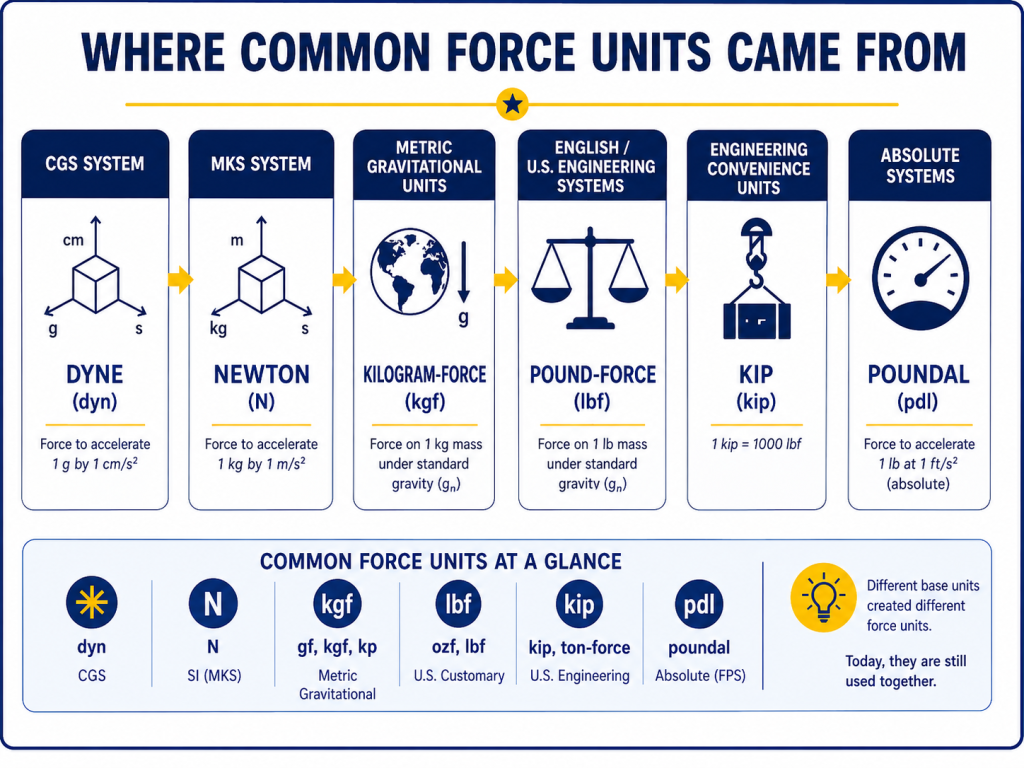
The centimeter-gram-second system, commonly called CGS, produced the dyne. The meter-kilogram-second system, or MKS, led to the newton. Gravitational metric systems produced units such as kilogram-force. Meanwhile, English and U.S. engineering practice retained pound-based units such as pound-force and kip.
The International System of Units eventually provided a coherent international framework for measurement. However, older and regional units did not disappear.
As a result, today’s engineer, technician, or calibration laboratory may work with SI and non-SI force units during the same project.
The Dyne and the CGS System
One of the older metric measurement systems was the centimeter-gram-second system.
As its name suggests, CGS used the centimeter for length, gram for mass, and second for time. Its derived unit of force is the dyne, symbol dyn.
A dyne is the force required to accelerate a mass of one gram at one centimeter per second squared.
Converted to SI units:
1 dyn = 10⁻⁵ N
The NIST SP 811 force conversion tables provide the dyne-to-newton relationship along with conversions for several other historical and non-SI force units.
The dyne is uncommon in modern industrial force calibration. Nevertheless, it remains historically important because it demonstrates how the base units selected for a measurement system determine the resulting derived force unit.
The MKS System and the Origin of the Newton
Another metric framework used the meter, kilogram, and second as its mechanical base units. This became known as the MKS system.
Within that system, force naturally takes the form:
kg·m/s²
The name newton was formally adopted for the MKS unit of force by the 9th General Conference on Weights and Measures, or CGPM, in 1948.
The unit was named after Isaac Newton because of his fundamental contributions to mechanics.
Its symbol is:
N
Therefore:
1 N = 1 kg·m/s²
The modern International System of Units continues to use the newton as the coherent derived unit of force.
The BIPM SI Brochure provides the international definition and conventions for SI quantities and units.
SI Force Units and Prefixes
One major advantage of SI is that very small and very large forces can be expressed using standardized decimal prefixes without creating entirely different force units.
For example:
| Unit | Symbol | Equivalent |
|---|---|---|
| micronewton | µN | 0.000001 N |
| millinewton | mN | 0.001 N |
| newton | N | 1 N |
| dekanewton | daN | 10 N |
| kilonewton | kN | 1,000 N |
| meganewton | MN | 1,000,000 N |
The physical quantity remains force. The prefix simply changes the magnitude represented by the unit.
A small-force sensor might be specified in millinewtons, while a high-capacity force calibration machine may operate in kilonewtons or meganewtons.
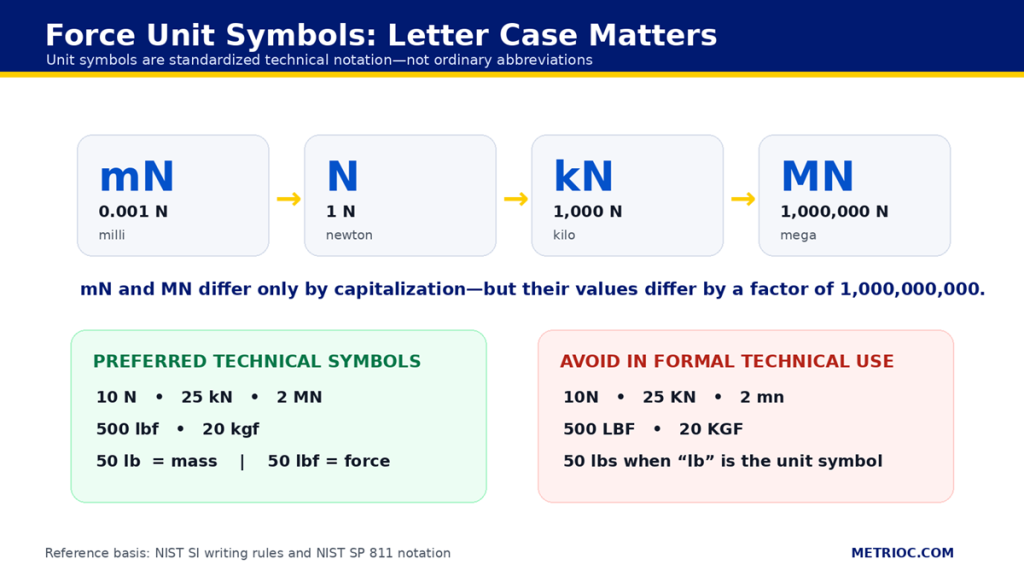
The symbols used for SI prefixes are standardized and case-sensitive. The NIST guidance for writing SI units explains capitalization, spacing, prefixes, plurals, and other important unit-writing conventions.
This becomes especially important when comparing mN and MN.
1 mN = 0.001 N
while:
1 MN = 1,000,000 N
The difference between 1 mN and 1 MN is a factor of one billion.
Therefore, changing a single letter from lowercase to uppercase can completely change the meaning of a measurement.
Kilogram-Force and Other Gravitational Metric Force Units
Not every metric-based force unit is an SI unit.
One important example is the kilogram-force, symbol kgf.
Kilogram-force developed from a gravitational approach to force. It corresponds to the force associated with a one-kilogram mass under the conventional standard acceleration of gravity.
The conventional standard acceleration of gravity is:
gₙ = 9.80665 m/s²
Therefore:
1 kgf = 9.80665 N
The NIST SP 811 force conversion tables give this relationship directly.
Another historical name is the kilopond, symbol kp. One kilopond is equivalent to one kilogram-force.
A related smaller unit is gram-force, symbol gf.
Although kgf, kp, and gf are not coherent SI force units, they may still appear on older force gauges, testing equipment, imported instruments, product specifications, and legacy calibration records.
For formal SI reporting, the newton remains the preferred force unit.
U.S. Customary and English Engineering Force Units
The phrase American standard system is sometimes used informally. However, U.S. customary units, inch-pound units, or English engineering units are more technically appropriate descriptions.
Force measurement in the United States still makes extensive use of pound-based units, particularly in calibration, mechanical testing, aerospace, structural engineering, weighing, lifting, and load-cell applications.
The most important of these units is pound-force.
Pound-Force: lbf
The pound-force, symbol lbf, is one of the most widely used non-SI force units in U.S. engineering and force calibration.
Using the conventional standard acceleration of gravity:
1 lbf = 4.4482216152605 N
The NIST SP 811 force conversion tables provide the conversion relationships used for pound-force and other commonly encountered force units.
For routine engineering calculations, the pound-force conversion may be displayed with fewer digits:
1 lbf ≈ 4.44822 N
However, the availability of a long conversion factor does not mean that every converted measurement should be reported with all of those digits.
The precision of the final result should still reflect the precision and uncertainty of the original measurement.
Ounce-Force: ozf
For smaller forces, ounce-force, symbol ozf, may also be encountered.
Approximately:
1 ozf ≈ 0.2780139 N
Ounce-force may appear in lower-capacity force gauges, spring testing, component testing, and other applications where pound-force would result in inconveniently small numerical values.
What Is a kip?
A kip is a convenient unit used to express relatively large forces.
By definition:
1 kip = 1,000 lbf
Therefore:
1 kip ≈ 4.44822 kN
kips are especially common in structural engineering and high-capacity mechanical testing because they avoid repeatedly writing very large values in pound-force.
For example:
100,000 lbf = 100 kip
Similarly:
500,000 lbf = 500 kip
For engineers working with high-capacity load cells, structural test systems, and force calibration equipment, the kip can provide a convenient scale between lbf and very large numerical values.
Ton-Force
Another unit sometimes used for large forces is ton-force.
For the U.S. short ton:
1 short ton-force = 2,000 lbf
This corresponds to approximately:
1 short ton-force ≈ 8.89644 kN
The word ton can be ambiguous because multiple definitions of ton exist internationally.
For technical specifications, reports, and calibration records, it is therefore better to identify the intended ton-based unit clearly rather than reporting a force simply as “10 tons.”
The Poundal
The poundal is an older force unit associated with an absolute foot-pound-second system.
Unlike pound-force, its definition follows directly from mass and acceleration in that unit system.
A poundal is the force required to accelerate a one-pound mass at one foot per second squared.
Approximately:
1 poundal ≈ 0.138255 N
The poundal is rarely encountered in modern industrial force calibration. However, its existence helps explain an important historical distinction between coherent mechanical force units and gravitational force units.
lb and lbf Are Not the Same Thing
One common source of confusion deserves a short explanation.
The pound, symbol lb, is a unit of mass.
The pound-force, symbol lbf, is a unit of force.
They represent different physical quantities.
For example:
50 lb represents mass.
50 lbf represents force.
The relationship between mass and the gravitational force acting on that mass involves acceleration due to gravity:
F = mg
That distinction becomes especially important in high-accuracy metrology because the actual acceleration due to gravity is not identical everywhere on Earth.
This article will not explore that subject in detail because mass-to-force conversion deserves a separate discussion.
A future Metrioc article on mass-to-force conversion can examine local gravity, standard gravity, latitude, elevation, deadweight force generation, air buoyancy, and why using 9.80665 m/s² is not always equivalent to calculating the actual gravitational force produced by a mass at a particular location.
Why Correct Force Unit Symbols Matter
Correct unit notation is not merely cosmetic.
Unit symbols are standardized technical symbols rather than ordinary abbreviations. Their capitalization, spacing, and formatting communicate specific information about a measurement.
The NIST guidance for writing SI units provides practical rules for unit names, symbols, capitalization, spacing, punctuation, prefixes, and plurals.
Consider the following examples:
| Preferred notation | Avoid in formal technical use |
| N | n |
| kN | KN or Kn |
| MN | mn |
| mN | MN when millinewton is intended |
| lbf | LBF |
| kgf | KGF |
| lb | lbs as the formal unit symbol |
| 100 N | 100N |
Why N Is Capitalized
When the name of the unit is written out, newton normally begins with a lowercase letter.
However, its symbol is uppercase:
N
This follows the SI convention for unit symbols derived from proper names.
Therefore:
newton is the written unit name.
N is the unit symbol.
Why kN Is Not KN
The SI prefix kilo uses a lowercase k.
Therefore:
kN
means kilonewton.
Writing KN does not follow standardized SI notation.
Why mN and MN Cannot Be Interchanged
The lowercase prefix m means milli:
m = 10⁻³
The uppercase prefix M means mega:
M = 10⁶
Therefore:
1 mN = 0.001 N
while:
1 MN = 1,000,000 N
The two values differ by a factor of one billion.
In technical documentation, capitalization can therefore change the actual numerical meaning of a measurement.
Why lbf Is Better Than LBF
The NIST force conversion tables use lbf as the symbol for pound-force.
For consistent technical notation, lbf should therefore be used rather than informal variations such as LBF, LB-F, or LbsF.
This distinction is particularly useful on calibration certificates, test reports, specifications, software interfaces, databases, and machine-readable measurement records.
Put a Space Between the Number and the Unit
Technical writing normally separates the numerical value from its unit symbol with a space.
Write:
100 N
rather than:
100N
The NIST guidance for writing SI units explains the standard spacing conventions used when expressing numerical values and units.
Using consistent spacing also improves readability in calibration certificates, procedures, engineering reports, and technical publications.
Unit Symbols Are Not Pluralized
A unit symbol does not change because the numerical value is greater than one.
Write:
1 N
and:
100 N
not:
100 Ns
Likewise, the symbol for pound remains:
lb
whether the value is 1 lb or 50 lb.
This is why lbs, although extremely common in everyday writing, is not the formal unit symbol.
Force Is Not Torque or Pressure
Force units also appear inside units for other mechanical quantities, but those quantities should not be confused.
Force may be expressed in units such as:
N
kN
MN
lbf
kip
Torque or moment of force may be expressed in units such as:
N·m
lbf·ft
lbf·in
Pressure and stress represent force divided by area.
For example:
1 Pa = 1 N/m²
and pound-force per square inch is commonly expressed as psi.
Force, torque, pressure, and stress are different physical quantities even when their unit expressions contain some of the same force symbols.
Common Force Units and Their SI Equivalents
The following table summarizes several force units commonly encountered in engineering, calibration, scientific literature, and legacy equipment.
| Force unit | Symbol | System or common use | SI equivalent |
| dyne | dyn | CGS | 0.00001 N |
| millinewton | mN | SI | 0.001 N |
| newton | N | SI | 1 N |
| dekanewton | daN | SI | 10 N |
| kilonewton | kN | SI | 1,000 N |
| meganewton | MN | SI | 1,000,000 N |
| gram-force | gf | gravitational metric | 0.00980665 N |
| kilogram-force | kgf | gravitational metric | 9.80665 N |
| kilopond | kp | legacy metric | 9.80665 N |
| ounce-force | ozf | U.S. customary | approximately 0.278014 N |
| pound-force | lbf | U.S. customary | approximately 4.44822 N |
| kip | kip | U.S. engineering | 1,000 lbf |
| short ton-force | — | U.S. customary | 2,000 lbf |
| poundal | pdl | absolute FPS | approximately 0.138255 N |
For practical conversions between these and other measurement units, use the Metrioc Force Unit Converter.
Which Force Units Are Commonly Used Today?
Different force units remain common because the preferred unit often depends on the application, industry, country, equipment, and customer requirements. SI units dominate international scientific and engineering work, while U.S. force calibration and structural testing still make extensive use of pound-force and kip.
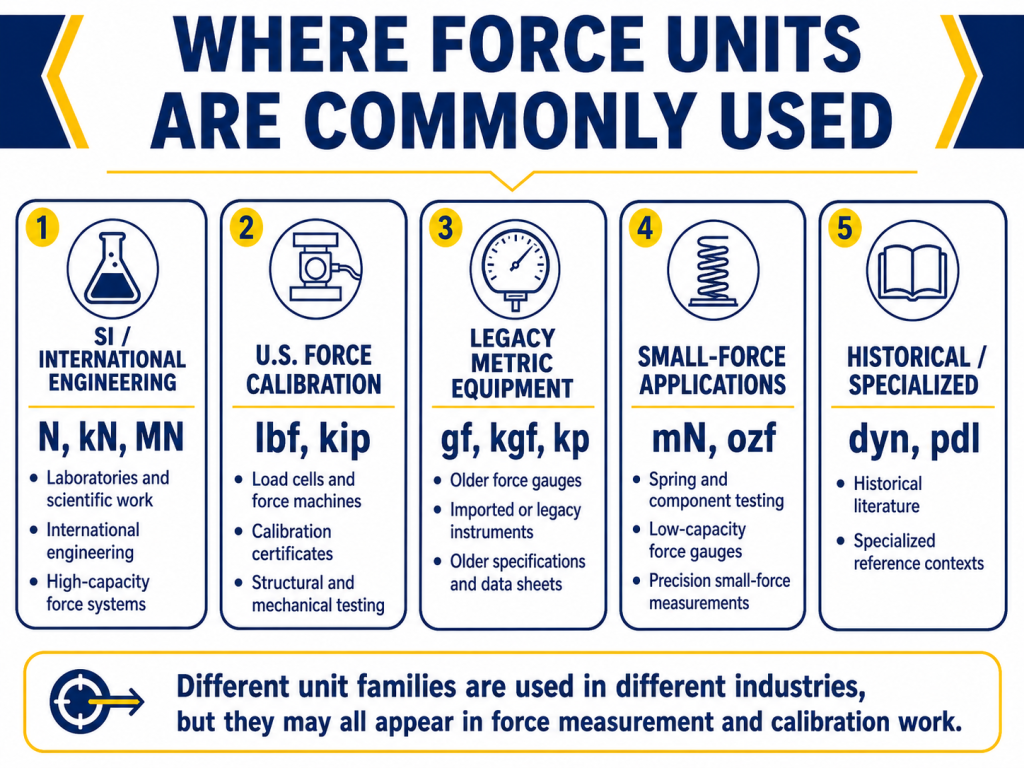
For international scientific, laboratory, and engineering work, the most common force units are generally N, kN, and MN. These units belong directly to SI and scale conveniently from relatively small forces to high-capacity force measurements.
In U.S. engineering and force calibration, lbf remains extremely common. The unit kip is frequently used when force values become large, particularly in structural testing, high-capacity load-cell applications, and force calibration systems.
Smaller-force applications may use mN or ozf, while kgf, gf, and kp continue to appear on some older or internationally manufactured equipment.
Units such as dyn and pdl are now encountered mainly in historical literature or specialized technical contexts.
Unit Conversion Does Not Increase Measurement Accuracy
An important metrology principle is often overlooked when converting force units:
Changing the unit does not improve the measurement.
Suppose a force is reported as:
10,000 lbf
Using the pound-force-to-newton relationship, a calculator can produce:
44,482.216152605 N
Mathematically, the conversion is valid.
Metrologically, however, displaying every digit may be misleading.
If the original value was known only to the precision implied by 10,000 lbf, conversion software cannot create additional information about that measurement. It cannot improve the instrument resolution, repeatability, calibration uncertainty, stability, or measurement traceability.
The converted result should therefore be reported with a number of digits appropriate to the original measurement and its uncertainty.
This is why force-unit conversion and significant digits belong together.
For a detailed discussion of appropriate numerical reporting, read Rounding Measurement Uncertainty on Calibration Certificates: Significant Digits, ILAC P14, and NIST Rules.
That article explains the difference between significant digits and decimal places, why intermediate calculations should retain adequate precision, and how rounding affects final calibration results and uncertainty statements.
You can also use the Metrioc Significant Figures Calculator to round values to a selected number of significant figures and compare common rounding with the NIST SP 811 exact-tie method.
Converted the Units? Now Check the Significant Digits.
A unit converter can display many decimal places, but that does not mean every displayed digit belongs in the final measurement result.
First, convert the quantity using a reliable conversion factor such as the Metrioc Force Unit Converter.
Then, determine how many digits are justified by the original value, measurement resolution, uncertainty, reporting procedure, and intended use. The Metrioc Significant Figures Calculator can help with the final numerical presentation.
For additional background, see Metrioc’s guide to significant digits and calibration-certificate rounding.
Why Force Conversion Factors Need Reliable Sources
Force conversion factors are available from countless websites and calculators. However, technical work should rely on recognized and traceable references.
NIST Special Publication 811 is especially useful because its appendices organize conversion factors by physical quantity and provide conversions for many SI and non-SI units.
Its force tables include units such as dyne, kilogram-force, kilopond, kip, ounce-force, poundal, pound-force, and ton-force.
The Metrioc converter is designed around the NIST SP 811 conversion framework so users can work with force and other measurement quantities without manually entering conversion factors.
Force Units on Calibration Certificates
Correct force units are particularly important on calibration certificates because each reported number must communicate its intended physical quantity without ambiguity.
A force calibration certificate may include applied force, indicated force, error, correction, resolution, measurement uncertainty, calibration range, and other numerical results.
Consider these two entries:
50,000 lbf
and:
50,000 lbs
A person familiar with the application might infer that the second value was intended to represent force.
A technical record should not require that inference.
The first notation explicitly identifies the quantity as pound-force.
The same principle applies to SI values. A certificate showing 500 kN follows standard notation. Writing 500 KN does not.
Consistent unit notation becomes even more important when calibration data moves between people and software systems.
Results may be transferred from calibration software into spreadsheets, laboratory information management systems, databases, test systems, customer portals, automated certificates, or APIs.
A person may recognize an incorrect symbol from context. Software may instead interpret it incorrectly or fail to recognize it entirely.
Correct unit notation therefore supports both technical clarity and reliable digital data handling.
Standards and References for Force Units
Several authoritative publications are particularly useful when establishing how force quantities, unit symbols, and conversions should be expressed.
BIPM SI Brochure
The BIPM SI Brochure is the primary international reference for the International System of Units.
It establishes the SI framework and identifies the newton as the coherent derived SI unit of force.
It is the best high-level international reference for SI quantities, units, symbols, and prefixes.
NIST Special Publication 330
NIST Special Publication 330 presents the International System of Units for use in the United States.
It is an important companion to the BIPM SI Brochure for U.S. laboratories, manufacturers, engineers, and technical organizations.
NIST Special Publication 811
NIST Special Publication 811 is one of the most practical references for technical work involving measurement units.
It addresses unit symbols, prefixes, capitalization, spacing, formatting conventions, conversion factors, and the use of units outside SI.
Its Appendix B conversion tables are particularly useful when working with force units.
ISO 80000-1:2022
ISO 80000-1:2022 — Quantities and units — Part 1: General establishes general principles and definitions for quantities, systems of quantities, units, quantity symbols, unit symbols, and coherent systems of units.
It is a useful ISO reference for the terminology and notation principles discussed in this article.
ISO 80000-4:2019
ISO 80000-4:2019 — Quantities and units — Part 4: Mechanics addresses names, symbols, definitions, and units for quantities in mechanics.
Because force is a mechanical quantity, Part 4 is particularly relevant to this subject.
What About ASTM E74 and ISO 376?
ASTM E74 and ISO 376 are highly relevant to force calibration, but they serve a different purpose from the SI and quantity standards discussed above.
Documents such as the BIPM SI Brochure, NIST SP 330, NIST SP 811, and ISO 80000 establish broader conventions for quantities, units, symbols, and conversions.
ASTM E74 and ISO 376 deal more directly with the calibration and evaluation of force-measuring instruments.
The distinction is important.
A standard governing how a force-measuring instrument is calibrated is not necessarily the same standard that establishes how physical quantities and their units should be written.
Frequently Asked Questions About Force Units
What is the SI unit of force?
The SI unit of force is the newton, symbol N.
1 N = 1 kg·m/s²
What is the difference between lb and lbf?
lb is a unit of mass.
lbf is a unit of force.
They represent different physical quantities and should not be used interchangeably in formal technical work.
Is lbs the correct unit symbol?
No.
The formal symbol for pound is lb.
Unit symbols are not pluralized, so the symbol remains lb regardless of whether the numerical value is 1 lb, 2 lb, or 100 lb.
Is LBF the correct symbol for pound-force?
The notation used by NIST for pound-force is lbf.
For technical consistency, lbf is preferable to LBF and other informal variations.
How many newtons are in one pound-force?
Using the standard relationship:
1 lbf = 4.4482216152605 N
How many pounds-force are in one kip?
1 kip = 1,000 lbf
Is kilogram-force an SI unit?
No.
The coherent SI unit of force is the newton.
Kilogram-force is a gravitational metric force unit.
How many newtons are in one kilogram-force?
1 kgf = 9.80665 N
Is kg the same as kgf?
No.
kg is a unit of mass.
kgf is a unit of force.
Why is MN different from mN?
The uppercase prefix M means mega, or 10⁶.
The lowercase prefix m means milli, or 10⁻³.
Therefore:
1 MN = 1,000,000 N
while:
1 mN = 0.001 N
They differ by a factor of one billion.
Why should I write kN instead of KN?
The SI prefix kilo uses the lowercase symbol k.
Therefore, kilonewton is written kN.
Should I keep every decimal place after converting force units?
No.
A mathematical conversion may produce many decimal places, but the final reported value should reflect the precision and uncertainty of the original measurement.
For more information, read Metrioc’s guide to significant digits and calibration-certificate rounding or use the Metrioc Significant Figures Calculator.
Final Thoughts
Force units reflect the history and development of measurement science.
The dyne came from the CGS system. The newton developed from the MKS system and became the coherent SI unit of force. Kilogram-force reflects a gravitational metric approach, while pound-force and kip remain important in U.S. engineering and force measurement.
These different systems continue to meet in modern laboratories, manufacturing facilities, test environments, engineering specifications, and calibration certificates.
Understanding the units is only part of the job. Using them correctly is equally important.
N is not the same notation as n.
kN should not become KN.
mN and MN differ by a factor of one billion.
lb and lbf describe different physical quantities.
The formal symbol lbf is preferable to LBF in technical documentation.
Finally, converting a force measurement from one unit to another does not create additional measurement accuracy. The converted result should still be expressed with numerical precision appropriate to the original measurement and its uncertainty.
For practical conversion work, use the Metrioc NIST SP 811 Unit Converter.
After converting a value, use the Metrioc Significant Figures Calculator when you need to express the result with an appropriate number of significant digits.
For a deeper discussion of calibration results, measurement uncertainty, and numerical reporting, read Rounding Measurement Uncertainty on Calibration Certificates: Significant Digits, ILAC P14, and NIST Rules.
Correct unit selection, standardized notation, reliable conversion factors, and appropriate significant digits all contribute to one goal: communicating a measurement clearly and accurately.